- Current delivery-flow and release-risk assessment
- Repository, identity, secrets and pipeline protection
- CI/CD architecture and reusable delivery patterns
- Automated build, test, deployment and rollback
- SAST, DAST, dependency, container and infrastructure checks where agreed
- Artifact governance, release evidence, vulnerability response and pipeline observability
Automate deliveryService 02
DevSecOps as a Service
Turn secure, repeatable delivery into an operated capability—not a collection of pipeline tools and late approval gates.
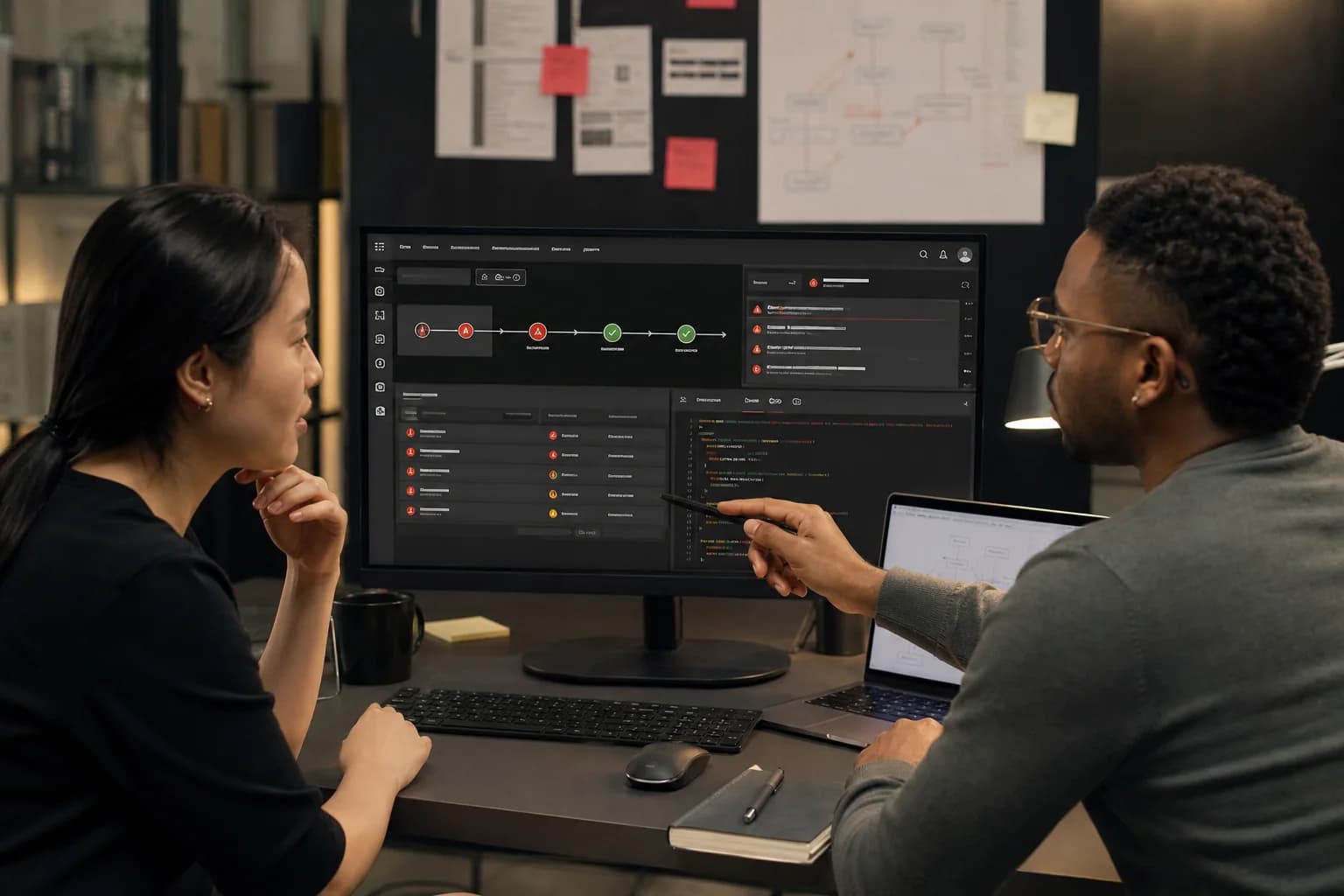
Pipeline · Controls · Evidence
Service definition
Clear scope, tangible outputs and explicit boundaries.
Final responsibilities, coverage and service levels are confirmed in the statement of work and service agreement.
- Delivery baseline and prioritized control backlog
- Pipeline architecture and reusable templates
- Control, evidence and exception-handling map
- Artifact, dependency and provenance governance pattern
- Release, rollback and vulnerability-response runbooks
- Pipeline-health dashboard and improvement cadence
- A promise that tools alone create compliance
- Replacement of customer risk acceptance or release authority
- Product licensing, vendor support or independent security certification unless contracted
- Repository and delivery-tool access
- Security and release-policy owners
- Representative applications and environments for validation
Jenkins · GitLab CI · GitHub Actions · SonarQube · Terraform · Kubernetes
Control alignment- NIST SSDF-informed secure development practices
- Policy and approval evidence
- Vulnerability response traceability
Service definition reviewed . Platform versions, responsibilities and service targets are validated for each engagement.
 01 · Delivery phase
 Phase 01
Map the delivery system
Baseline the flow from commit to production, including repositories, identities, dependencies, handoffs, recovery and evidence gaps.
- Delivery-flow and release-risk assessment
- Repository, identity and secrets controls
Decision gateAgreed delivery baseline, risks and control priorities
OutcomeDelivery baseline established
 02 · Delivery phase
 Phase 02
Engineer the secure path
Build reusable pipelines, tests, policy checks, artifact controls and rollback into the normal delivery workflow.
- Reusable CI/CD and deployment automation
- Policy gates, artifact governance and release evidence
Decision gateTested pipeline path and traceable control evidence
OutcomeReusable control path
 03 · Delivery phase
 Phase 03
Operate and improve
Monitor pipeline health, respond to vulnerabilities, review delivery performance and maintain a visible improvement backlog.
- Pipeline monitoring and vulnerability response
- Delivery measures and a managed improvement backlog
Decision gateAccepted runbooks, measures and ownership cadence
OutcomeImprovement cadence
Measurement model
Success defined before the work begins.
Baselines, targets, measurement windows and owners are agreed for the actual engagement scope.
Time from committed change to production deployment.
Production deployments completed in the agreed measurement period.
Time to recover from a deployment-related failure.
Deployed changes requiring remediation, rollback or urgent correction.
Ratio of deployments that were unplanned and made to address a production incident or user-facing defect.
Share of in-scope pipelines and repositories applying the agreed automated checks with traceable evidence.
Related proof
Building a secure OpenShift platform
For mission-critical workloads across non-production, production and disaster recovery.
Read the story
FAQ
Common questions about devsecops as a service.
Clear answers for decision-makers before the first engineering workshop.
Talk to an engineerCan ExpertOps improve our existing pipelines and toolchain?
Yes. The engagement begins by mapping the current delivery path, controls and failure points. ExpertOps retains tools and patterns that remain fit for purpose, improves or replaces the constrained parts, and validates compatibility before the target path is accepted.
Who decides whether a security finding blocks a release?
Blocking thresholds, evidence, exception handling and escalation are defined with customer engineering, security and risk owners. ExpertOps engineers and can operate the agreed controls; customer owners retain the release authority and risk-acceptance decisions assigned to them.
What happens when an automated check finds a vulnerability?
Within the agreed scope, findings are triaged, assigned an owner and tracked against risk-based remediation targets. False-positive and exception decisions remain traceable, while application, platform, customer and vendor responsibilities are documented before operation begins.
Which cloud and platform technologies do you operate?
Our teams work across AWS, Azure, Google Cloud, Oracle Cloud, IBM Cloud, Kubernetes, Docker and Red Hat OpenShift, supported by modern CI/CD, IaC and observability tooling.